"Opening Day Trout Season Tactics"
by Mike Mercer
Well, its that time of year again. We're fortunate to live in a part of the world that boasts some great year-round angling, but there is something about the mountain stream opener that always jacks my anticipation level into high gear. Beautiful native trout, hungry and naive after a long winter without any angler pressure-sign me up! With the exception of drought years, however, water conditions are often less than perfect for the Opener. This isn't necessarily a bad thing- just a challenge that can make catching fish a bit more difficult, and rewarding. It appears this season will be fairly typical, with precipitation levels hovering right around normal, as of this writing. Let's take a look at some of our fisheries, and good early season strategies for each.

HAT CREEK-
This wonderful spring creek is always an early season favorite, as it has virtually guaranteed low, clear water conditions. The Powerhouse 2 stretch is the most popular, with it's classic heavy riffle that gradually softens into one of the most celebrated, difficult chalkstream rivers in the West. If you are an angling social butterfly, unafraid to rub elbows with your fellow fisherman, you'll find some fun stuff here. Early May finds the riffle loaded with feeding rainbows and browns, most drawn here by an impressive volume of wiggling fish food tumbling helplessly in the swift currents. The remainder are large spawners still residing in the trough, from the winter/spring spawn. For the first couple days of the season any small nymph, dead-drifted, will catch fish. The trout here wise up quickly, however, and by the second week of the season you need to be on top of your game (and persistent!) to consistently hook fish. A great rule of thumb on this riffle is to think small. A large percentage of the aquatic critters rolling down this stretch are midges, tiny mayflies, micro-stones and micro-caddis. Make your fly selections accordingly, using patterns in the 16-22 size range. Fish them on 6x and 7x, and use the tiniest yarn indicator and split shot available. As in most indicator nymphing, set the fly approximately one and one half times the depth of water being fished, beneath the indicator.

As the riffle turns to flat water, the fishing really gets interesting (a.k.a.- tortuously difficult). These trout can be unbelievably selective- you earn every fish you hook here. There will literally be days when two or three fish will constitute a successful outing. Dead-drifts are your friend here, and we mean 4-6 feet of tippet, stack cast, feeding line while holding your mouth just right dead drifts. These fish simply do not tolerate imperfections in your presentation (at least not once they achieve trout adulthood-over 12 inches).

This section of Hat Creek has some amazing compound hatches, with 4-6 types of insects sometimes crowding the rivers surface. The angler must be able to "read" rise forms, to have a chance at figuring out what the fish are keying on at any given time. For the first several weeks of the season, come prepared with plenty of P.M.D. emergers and adult patterns in the 16-18 size range. (Later in the summer the average mayfly size will shrink even smaller). Also, be prepared for myriad other bugs, such as blue winged olives, green drakes, micro-caddis, golden stones and salmonflies, mahoganies, little yellow stones, flying antsÖ.well, you get the picture. And don't overlook the nymphing potential here, either- the same flies and techniques as used in the upstream riffle can be quite effective in these flats.

Which brings us to the much-overlooked, but beautiful lower riffles. There isn't a very impressive fish-per-mile count down here, but this unique piece of water has a healthy population of salmonflies, which makes it a fun place to throw "big bugs" early in the season. The first month of the season features excellent nymphing, both with large stones and assorted smaller wets. Typically, the dry stone hatches begin in late May and last through the month of June. After that, it's best to wait 'til the cool temperatures come back in the fall, down here.

TRINITY RIVER-
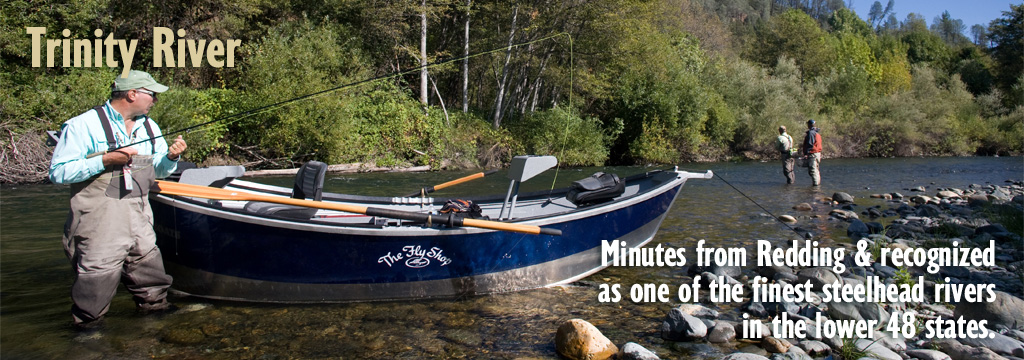
We're really excited about the possibilities of this fishery - with the large steelhead run we experienced this winter, we expect a lot of holdovers to be left in the "FLY WATER". Typically, these fish respond well to lead-eyed baitfish patterns, San Juan Worms, and golden stone nymphs. The large holdovers love to eat the juvenile fish that are released into the river from the hatchery- on good years we'll hook 2-6 big fish a day on big, dead-drifted streamers!

PIT RIVER-
We never know whether water conditions will allow us to hit this spectacular little freestoner on Opening Day-but if they do, it can be fabulous. This is truly a place for the stout of body, with grueling death marches down the poison oak-strewn canyon floor the price of admission. And that's after the hike/slide down off the edge of the precipice from where you park. After driving for miles on twisty, paved mountain roads followed by miles on twisty, decidedly unpaved river access roads. Did I mention the rattlesnakes, bears and scorpions? Nevertheless, the avid nympher can experience the kind of outstanding "high-stick" action that can make all the bumps, bruises and body aches disappear like magic.

The Pit flows down a steep canyon from Lake Britton to Lake Shasta, dammed for it's hydroelectric potential many times along the way. By far the most popular stretch, the water between Britton dam and Powerhouse 3 is designated as a Wild Trout fishery. Its flows remain cool even during the dog days of summer, and it remains the most predictable of the river's reaches. It's not unusual to experience excellent dry fly fishing here in the spring and early summer, as well as incredible nymphing all year long. Because of it's special regulations designation, and consistent water temperature, it's also the most popular. Most foot traffic is concentrated around the dam and the powerhouse access, though, leaving miles of untrammeled classic pocket water. As a general rule, the faster and deeper the riffle, the more rainbows it will hold- this holds true for the entire river.

From P.H. 3 downstream, casual river access changes from limited to nearly non-existant, with the road winding high above the stream, but the entrepid angler can always find water. One of the best accesses is at the bottom of this stretch- parking where the flowing river enters the "lake" above the #4 dam, then walking upstream. Another favorite is the road leading to Deep Creek Campground, on the south side of the river. This road is nothing special, but rarely requires 4-wheel drive (depending on the harshness of the previous winter) and does open up several miles of water. On particularly scorching summers this water can warm up too much for good angling, so check ahead with us.

The final reach we spend a lot of time on is from the #4 dam down to P.H. 5. This encompasses the small mountain community of Big Bend, an excellent place to grab a quick bite in the middle of the day while tooling around from one riffle to another. Access points include the water right below the #4 dam, although you'll need to be prepared to do some cliff rappelling (I'm not kidding, here). More friendly are the accesses right around Big Bend and downstream at the P.H. 5 / river bridge to Iron Canyon Reservoir locales. Again, depending on the year, the summer fishing down here can be marginal. If possible, plan your trip to the Pit for the spring or fall.

FALL RIVER-
The topographical antithesis of the Pit, Fall River runs through an agricultural valley so perfectly flat there isn't even a single riffle marring it's placid surface. Fall River springs nearly full-size from it's headwaters at Thousand Springs Ranch, and slowly gains volume with the inflow of various creeks and springs on it's way downstream to it's confluence with the Pit, near Fall River Mills. Public fishing access is extremely scarce, limited to the Cal Trout boat access on Island Rd. and the P.G.and E. Dredge boat access on the lower river. For an incredible experience, try our Riverside House on Fall River- it puts you right on prime water (the dock is right out your back door!) with wonderful accommodations. All fishing on Fall River is done from boats, due to the private ownership nature of the watershed. Anglers anchor above rising pods of rainbows and feed downstream dry fly presentations to them, or swing or dead-drift nymphs down to known "fish hotels".

Typically, Fall is fishable but a little cold and off-color on Opening Day. The fishing can still be good, but with leeches and sinking lines, not dry flies. If we have a dry spring, look for scattered P.M.D. hatches right off the bat. One of the keys to finding fish on the Fall are locating subsurface weedbeds. These not only give trout physical hiding places, but are the start of the food chain for them, harboring vast quantities of mayflies, snails, scuds, damsels, leeches, etc. A little later in the spring, this monster spring creek will provide world class dry fly fishing.

UPPER SACRAMENTO RIVER-
Well, it looks like we may get two years in a row of average precipitation here, meaning no scouring winter floods (we're keeping our fingers crossed for a mild spring). This means good things for the Upper Sac, including more insects, more fishable water for the Opener and more and larger fish! Last year was encouraging, with the river seeming to rebound rapidly after a couple of years of ravaging floods. If the trend continues, expect to see more fish in the 12"-16"range. Also look for more predictable stonefly activity early in the season, followed by the mayflies in late May and June. There is incredible access to this classic freestone stream, making virtually every inch of it available to the "clambering angler". Yes, it is another canyon river, but unlike the Pit, it is a sunny, friendly environment with crystal clear riffles and inviting blue-green pools. High-stick nymphing is certainly effective here, though high floating yarn indicators allow us to fish water at greater distances from ourselves, sometimes an advantage in the Sac's ultra clear flows. Probably one of the most endearing habits of these "rocket rainbows", though, is their willingness to rise to dries. Not enough people fish big attractor dry flies here- it truly is a productive and thrilling way to spend an afternoon and evening in the early season. Towards the end of May and all through June, hanging a little Micro-Mayfly or H.B.I. nymph under a high floating floater is absolutely deadly.

The Upper Sac truly has something to offer most anglers, from it's small stream character above Dunsmuir to the deep, inviting big-fish water above Lake Shasta. It's close to all the amenities a travelling angler could want, and probably qualifies as our most underutilized fishery. Keep an eye on this one!

McCLOUD RIVER-
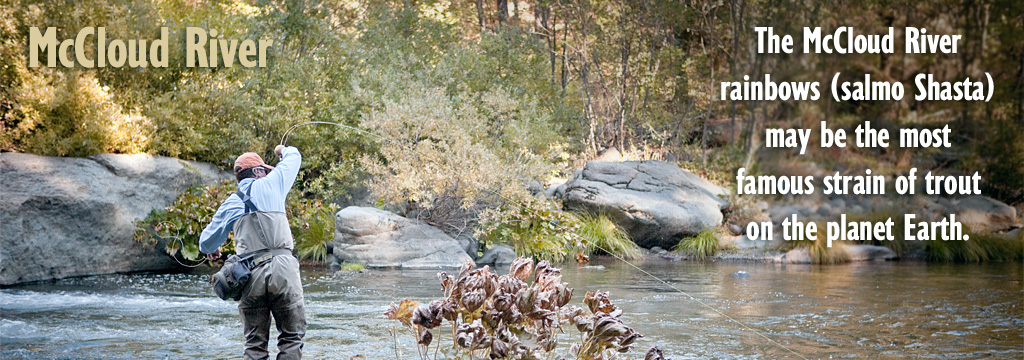
Most people would agree that this is one of the most pristine, beautiful rivers in California. It's lush, old growth corridor serpentines for miles between McCloud Reservoir and Lake Shasta, with much of it in private, untouchable ownership. Many of the rainbow trout made famous at destinations like New Zealand originated here. At the McCloud, there is much more to a day astream than only the fishing, however. Just the drive in serves up some breathtaking vistas of the glacially-colored McCloud Reservoir and the spectacular river canyon itself, along with the showy beauty of dogwood thickets in full, creamy-blossomed regalia. Just the diverse, dense undergrowth itself is impressive, in many places blocking your vision after only a few short yards. And to park at the end of the road (where a sign greets you to the Nature Conservancy), walk a short distance to the quaint caretakers cabin and find yourself immersed in an obviously protected environment- it's worth the effort alone. The Conservancy maintains rustic but comfortable walking trails along the rivers' edge- you'll amble along beneath a protective canopy of huge conifers and oaks, admiring the exotic look of streamside vine maples and orchid-like flowering vines.

Every single trip into the McCloud is an adventure. I've encountered (at close quarters) bears, deer, mountain lions, rattlesnakes, eagles and any number of other cool little critters I'd be unlikely to see elsewhere in full daylight. One day a giant pine tree fell over for no apparent reason, missing me by scant inches as I waded waist deep in a productive-looking run. And the fish! Nowhere can you find more beautiful rainbow trout- their hard, cold bodies bristling with indignation every time they're brought to hand. Opening Day is a chancy call here-it just all depends on the amount of precipitation we've had. The hard-core nympher can always find early season, high-water trout hanging out in flooded bankside eddies, but if the water is in good shape, indicator nymphing with a green drake or golden stone pattern can be fantastic. Understand, the McCloud is not a place to go to rack up big fish counts. Rather, go with expectations of hooking several beautiful trout in quietly spectacular surroundings- if you have a bunch of hookups it'll just be icing on the cake!

LOWER SACRAMENTO-
This phenomenal fishery is open all year, but Opening Day usually coincides with some great caddis fishing. As of this writing, 02/20/01, the river is down and wadeable, the weather is warm and the caddis are going nuts-by late April things should really be kicked into high gear. So far, the fish appear to be even larger than last year, if that's possible. As they continue to gorge on the caddis, they're really going to get huge!

SMALL STREAMS-
We are blessed with a wealth of small mountain creeks in northern California, and they are, for the most part, very lightly fished. If fishing for gorgeous native trout (typically 6"-12") in an uncrowded, intimate atmosphere is your idea of fun, ask us and we'll be happy to suggest a destination. Sometimes they're a bit high for the opener, but usually fish well by mid to late May.

If you'll be up for the Opener, be sure to come by the shop the day before, Friday, April 25th. This is our annual Opening Day Party, with lot's of free food, drinks, tackle and technique clinics, and our usual great up-to-the-minute stream and fishing reports. We open the doors at 7:30a.m., serve food from noon til 7:00, and sponsor free seminars 'til we close at 9:00p.m. Hope to see you there!

Tip Title Written By
"Lower Sacramento Indicator Set-Up" Terry Jepsen
"Shooting the Sac" Tim Fox
"Opening Day Tips and Tactics" Mike Mercer
"Perfect Last Day" Sandy Watts
"A Secret for Hard-Fished Waters" Mike Mercer
"The 3 Key Knots to Flyfishing Success" Woody Woodland
"A Day to Remember" Sandy Watts
"River Etiquette" Shane Kohlbeck
"How to Find Fish on Stillwaters" Zack Thurman

t r a v e l    o n - l i n e   s t o r e    c a t a l o g  r e q u e s t
g u i d e  s e r v i c e    p r i v a t e  w a t e r s    s t r e a m  r e p o r t
s c h o o l s    k i d s c a m p    a b o u t  u s


©1978-2008 The Fly Shop®